
Posted on 02.11.2021 |
Added in Tales From My Wildlife Allotment
I would like to start this blog with some good news which some probably already know. My wildlife allotment has been chosen as the winning garden in the BBC Gardeners World magazine Gardens of the Year 2021 competition. I was completely overwhelmed when I found out that I won as I never had thought I would even get into the last 8 gardens. After I was told in June that my allotment is among the finalists, a professional photographer came to my allotment in mid-July to take all the photos which were than used in the judging, which took place at the beginning of September. You can see a selection of the photos together with an interview in the November issue of the Gardeners World magazine.
The allotment is looking very autumnal now with many plants changing colours from green to buff, yellow, brown, orange and red. Some of the trees such as Pyrus pyrifolia and Aronia × prunifolia have beautiful red and orange autumn colours while some of the perennial plants such as Sanguisorba hakusanensis 'Lilac Squirrel' and Amsonia tabernaemontana have changed into a pretty yellow. I love trees but have run out of space to plant any more trees in the ground without casting too much shade. As I love pruning and shaping trees as well I thought growing bonsai trees would be a good alternative for me to be able to collect some more interesting trees. Some of the trees I already have now for example are Metasequoia glyptostroboides, Liquidambar styraciflua, Corylopsis sinensis, Nyssa sylvatica, Acer maximowiczianum, A. palmatum, Gingko biloba and Parrotia persica. All the trees are very young still and with the right pruning and shaping will hopefully grow into beautiful bonsai trees.
 The blue bench is housing my growing tree collection |
 Many perennial plants have changed into autumn colours as well |
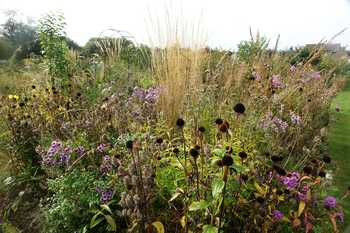 Some late asters are still flowering between the grasses and seed heads |
Grasses and seed heads are dominating the allotment now. Best of all the grasses at the moment are all the different Miscanthus sinensis cultivars with their silvery white seed heads and often colourful foliage. But many of the other grasses such as Sorghastrum nutans, Stipa calamagrostis and Anemanthele lessoniana look really good as well and provide structure and movement to the naturalistic plantings. I really like the flowers of Pennisetum alopecuroides as they look a bit like very hairy caterpillars and are very good at collecting the morning dew in pretty droplets after a cold night.
 Miscanthus sinensis and Sorghastrum nutans look at their best now |
 The seed heads of Pennisetum alopecuroides look like very hairy caterpillars |
 Seed heads and grasses in the mini-prairie |
We did not have any frosts yet so some plants are still flowering. Kniphoferi rooperi is looking very pretty with large orange flowers which really stand out and fit well with all the autumnal hues around it. Eucomis ‘Pink Gin’ has finished flowering but the seed head still looks good. Clematis integrifolia, which flowered in late spring and early summer, has produced fluffy seed heads which last quite a long time as long as wood mice don’t eat the seed which happened to some of mine. But as I like my little wood mice I don’t really mind.
 Kniphofia rooperi is still flowering |
 Eucomis 'Pink Gin' looks good even after it has finished flowering |
 The seed heads of Clematis integrifolia |
I don’t have many groundcover plants as my borders are densely planted but I could not resist to plant some Persicaria runcinata 'Purple Fantasy' as I liked the colourful patterned foliage so much. I planted it in full sun as apparently the leaf colours are much more intensive then. The plant seems to be happy and has even produced a few small pink flowers now. Many of the Eryngium seed heads look very good now, especially the seed heads of Eryngium giganteum, a biennial plant, which grows a rosette of leaves in the first year and large prickly flowers on tall stems in the second. The seed heads last a long time into winter but beware, this plant self-seeds a lot and I have to remove some of the seedlings every year as they would otherwise crowd out other, more delicate plants. I leave the allotment mainly alone at this time of year as many animals are looking for food and shelter, such as the little 7-spot ladybirds in the picture below, before winter arrives. It is also so much nicer so see all the seed heads and grasses instead of just looking at bare ground. I will do a big cut-back in late winter to make space for all the spring bulbs which will start flowering from February onwards.
 Persicaria runcinata 'Purple Fantasy' provides some pretty ground cover |
 Eryngium giganteum seed heads |
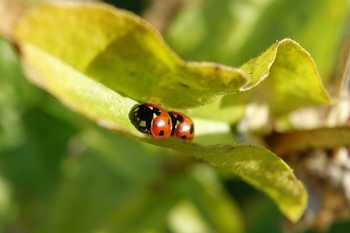 Two 7-spot ladybirds are sheltering in a leaf |
Some of the asters are still flowering such as some late-flowering Symphyotrichum novi-belgii cultivars and S. oblongifolium, which only really gets going in October. Thanks to the mild weather a few of the Verbascum nigrum plants have started flowering again. The flowers look really pretty close-up with the fluffy-looking purple stamens. Tricyrtis hirta has strange but quite beautiful flowers and enjoys a shady place under the cherry plum.
 Symphyotrichum novi-belgii flower on a cold morning |
 Verbascum nigrum var. album is flowering again |
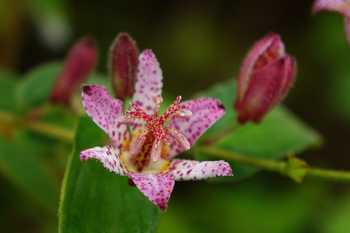 Tricyrtis hirta has strange but beautiful flowers |
Thanks to all the dense planting everywhere there is lots of cover for smaller animals such as all the frogs. I have seen several small frogs around the pond recently and a few larger ones in the flower borders. I hope they like eating the small slugs as these are very destructive in the vegetable beds. The spring cabbages I planted a couple of months ago have now completely disappeared, the same happened to some of the lettuce plants. I think this is actually the worst year for slug damage I ever had on the allotment as the spring was so cold and wet, especially in May, which gave the slug population a mighty boost. Thankfully, many perennial plants seemed to be fine after the initial onslaught and only some of the vegetables such as cabbage and lettuce suffered continuing damage in subsequent months.
 The allotment provides lots of cover for frogs and other wildlife |
 A frog hiding in the flower border |
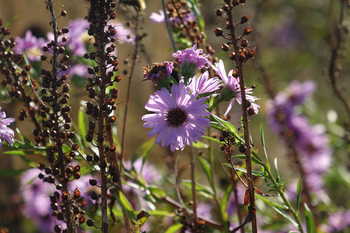 Michaelmas daisy with seed heads of Lysimachia ephemerum |
Most bumblebee workers have died now but new queens are safely tucked away somewhere warm and sheltered ready to awake next spring and start new colonies. The only bumblebees I still see flying around are common carder bumblebees (Bombus pascuorum). They are normally the last bumblebees you see in your garden before winter arrives in earnest. Good late-flowering bumblebee plants are single-flowered dahlias and Verbena bonariensis. They also like late aster flowers such as Symphyotrichum novi-belgii and S. oblongifolium. A few hoverflies are out and about as well, I photographed a very small one in a Papaver rupifragum flower.
 Two common carder bumblebees in a dahlia flower |
 Papaver rupifragum flower with a little hoverfly visiting |
 Common carder bumblebees love late-flowering Verbena bonariensis |
The weather has been quite mild so far but it is only a matter of time now until colder weather arrives. I will be back with more tales from my wildlife allotment, and hopefully some nice frosty photos, next month.
Nadine Mitschunas