

I ended last month by asking what July would bring us weatherwise – and as we all know it was the hottest July for 190 years, and we here had NO rain at all, as well as almost continuously above heatwave-threshold temperatures. So, I shall ignore the miserable gardening conditions I have been attempting to cope with and concentrate instead on how my Long Border developed during its’ first August after planting, in 2021. Last month I showed you up to 25th July, and I think you will agree the planting was not THAT dissimilar colour-wise to many of my other parts of the garden by that time – mainly blues/whites/pinks, very little of the bright vibrant colours of later summer that I hoped would be forthcoming.
So, by the second week in August the border planting looked a bit more vibrant in places: -
Starting with a long shot across from the front corner: -

You can see the Gladioli are vibrant, and the tall yellow stems of the Perennial Sunflower Helianthus ‘Loddon Gold’ to the left of the obelisk are starting to show. This angle shows the lavender hedge knitting together well to the left, (Lavendula angustifolium ‘Hidcote’), and the Penstemons and Gallardias along the front edge of the border. A couple of metres along the front edge, you can see the yellows of the Rudbeckia fulgida var. sullivanti ‘Goldsturm’ and Verbascum Olympicum as well: -

Continuing to walk along the front edge, the centre third looked like this: -

The small red flowers are the Salvia Microphylla ‘Royal Bumble,’ which flowers for months and months, as does the Verbena Bonariensis in front of it. Standing in the same spot but looking directly forward it looked like this: -

You can see the rusty colour of the Heuchera ‘Marmalade’ picked up in the flower colour of both gallardias either side. (Gallardia Aristata ‘Goblin’ to the left, and Gallardia x grandiflora ‘Burgunder’ to the right.) It also gives you an idea of the effect of the gabion wall as a backdrop to the planting of this border. From behind the middle third looks like this, with Rudbeckia ‘Green Wizard’ and Rudbeckia ‘Prairie Glow’ joining R. ‘Goldsturm,’ and showing well against the variegation of Phalaris arundinacea ‘Feesey’s Form’: -

Looking back from the far front corner, the Gallardia x grandiflora ‘Burgunder’ are more prominent now, set off by the small pale-yellow flowers of the Scabiousa ochroleuca behind it: -

From behind in this last third, you can see the three sorts of Echinacea flowering: - Echinacea ‘Green Twister;’ E. ‘Butterfly Mix’ and E purpurea ‘White Swan’: -

Some of the Helenium are now flowering – the Red version of my Helenium ‘Helena Mix’ and Helenium ‘Sahin’s Early Flowerer’: -


Although looking along the border my planting in waves made it look less dramatically colourful overall than if I’d planted in the big blocks favoured by the Prairie-style of planting, even with the young plants you can see blocks of punchy yellow in the Rudbeckia fulgida var. sullivanti ‘Goldsturm’: -

As August progressed, plants began to knit together more in some patches, (and not in others, which I took photographs of to make sure I knew which/what/where/when.)
From the front looking at the second and “silver” thirds: -

This gives a good indication of the effect the different heights of the plants made as you walk along that edge of the border, allowing you to see plants not just right at the front of the border, but in some places all the way to the back of the border. It also shows that I have made good use of different flower and leaf shapes in composing the planting plan too, not just different colours of flowers. The middle third from behind: -

And two shots from the front looking back from the far end, and then from slightly further along: -

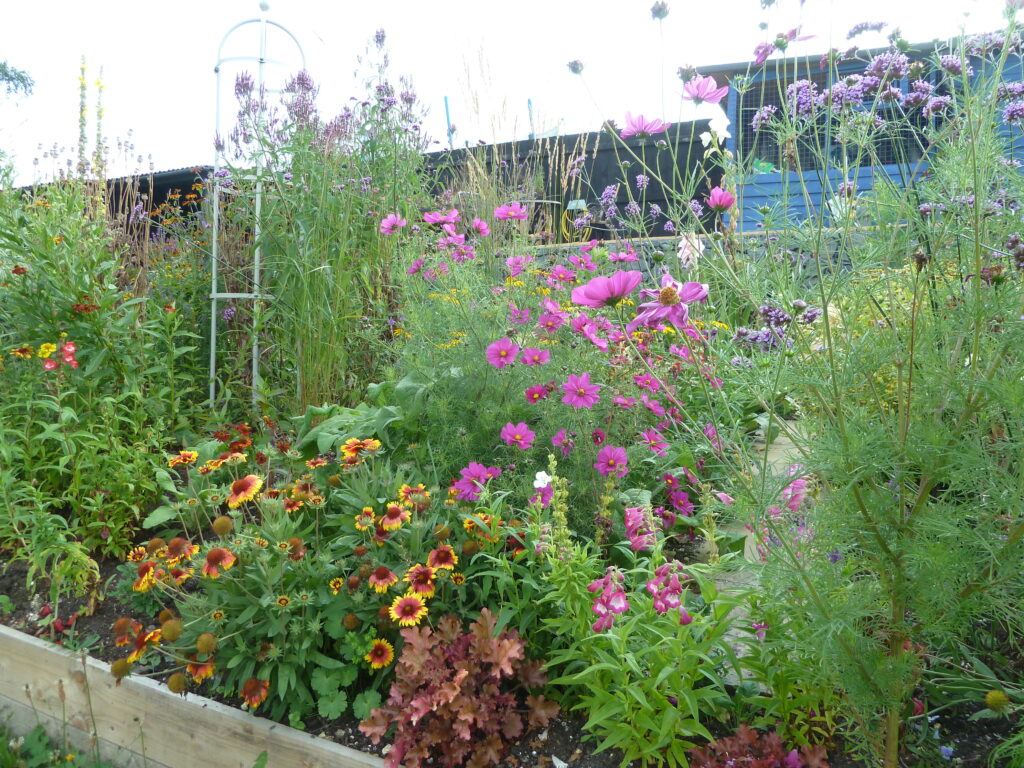
This latter clearly shows that a great deal of the colour at this part of the front of the border was coming from the Cosmos I’d grown from seed to fill in while the hardy perennial plants were young.
However, some patches of Heleniums were knitting together – here some of the yellow and red forms of the Helenium ‘Helena Mix’ planted behind the lavender hedge at the fern bed edge of the border: -

And further along the path between the ferns and this new border, the various Rudbeckias were making friends: -

Here is a shot showing how tall the Verbena Hastata ‘Blue Spires’ got that first year – both this one and the ‘White Spires’ really grew tall and bulky: -

I would certainly recommend these plants as they had started flowering in July as I showed you last month and continued in flower all through September too. They also seeded themselves into the weedy path between the Long Border and the Fern Bed and are easy to raise from seed. As you can see from the above picture, whilst not as “see through” as Verbena Bonariensis they have a good open habit in a border so you can peep through to plants behind. Talking of different heights of plants I put in the border, here is a shot from the front of the first third of the border to show you the front 5ft planting of the border: -

At the front here are the lower growing plants – Gallardias; Heuchera ‘Marmalade;’ Penstemon; Verbena Bonariensis to see through, and then behind the Rudbeckia fulgida var. sullivanti ‘Goldsturm.’ Behind that you can see the Helianthus ‘Loddon Gold’ and the Verbascum Olympicum, both as tall as the obelisk as well as the bulk of the variegated grass Phalaris arundinacea ‘Feesey’s Form.’ If I show you a “back view” of the border you can see the planting in the other 5ft depth of the border: -

You can see the Helenium ‘Helena Mix’ behind the Lavender Hedge; the Golden Rod (Solidago) and the White Michaelmas Daisy bushing up before it flowers behind them near the obelisk, and the Calamagrostis x Acutiflora ‘Karl Foerster’ to their left. To the right of the obelisk, you see the Helianthus ‘Loddon Gold’ from the other side. You may note that the Calamagrostis x Acutiflora ‘Karl Foerster,’ whilst a tall plant, was deliberately not planted along the central line of the border in line with the obelisk, but a little in front – so as not to have one long unbroken line of tall plants along the “spine” of the bed. The shot below shows the effect the paths through the border have in also creating the opportunity for different heights, with the Heleniums making a bold statement behind and along from the Calamagrostis: -

So, by the end of August, this border was definitely not looking like the rest of the garden either in planting, or colour, and was beginning to fill out much more than I expected.
You many have noticed I have not mentioned the Red-Hot Pokers or Alstromerias, as unfortunately none of these came up at all. A very few of the Japanese Anemone’s struggled up but did not amount to anything at all. I have had this trouble with these previously, having brought some of the White Anenome x hybrida ‘Honorine Joubet’ back from my sister’s front garden in Sheffield where they spread like mad, and they failed here on the chalk. I really don’t know why I am not successful with them here, as other people say they are tough and reliable!
Next month I shall show you how the Long Border moved through September and its first autumn. In the meantime, I have my fingers crossed we finally get some rain here during the second half of August!