

This month I am starting to think about how my garden coped with this summer’s weather, beginning with the flower garden. I shall start with hydrangeas as in July I had proudly shown you the Hydrangea arborescens ‘Strong Annabelle’ in their pots sat in trays up by the house looking good at the beginning of July. I think we were two heatwaves in then. We watered everything on 7 July and were at the RHS Badminton Flower Show on the 8th, in heat that was in the mid-30’s - so hot the ice cream vans’ machinery stopped working. The heat just kept building from that day on, and within three days the hydrangeas had gone from this: -
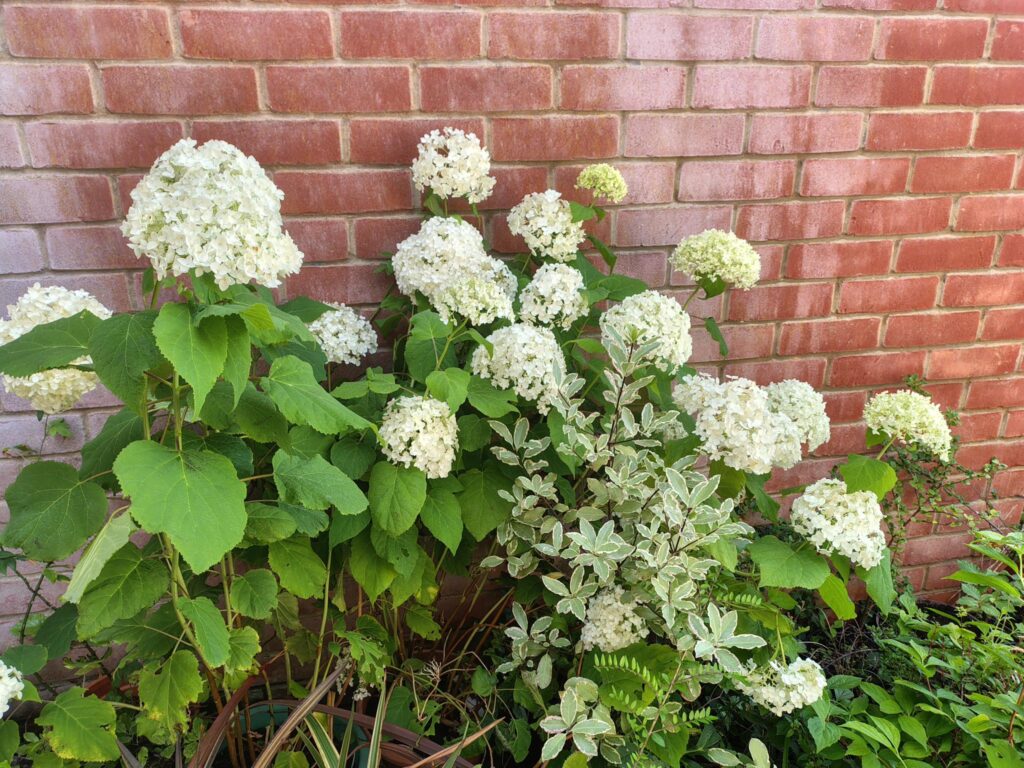
to this: -
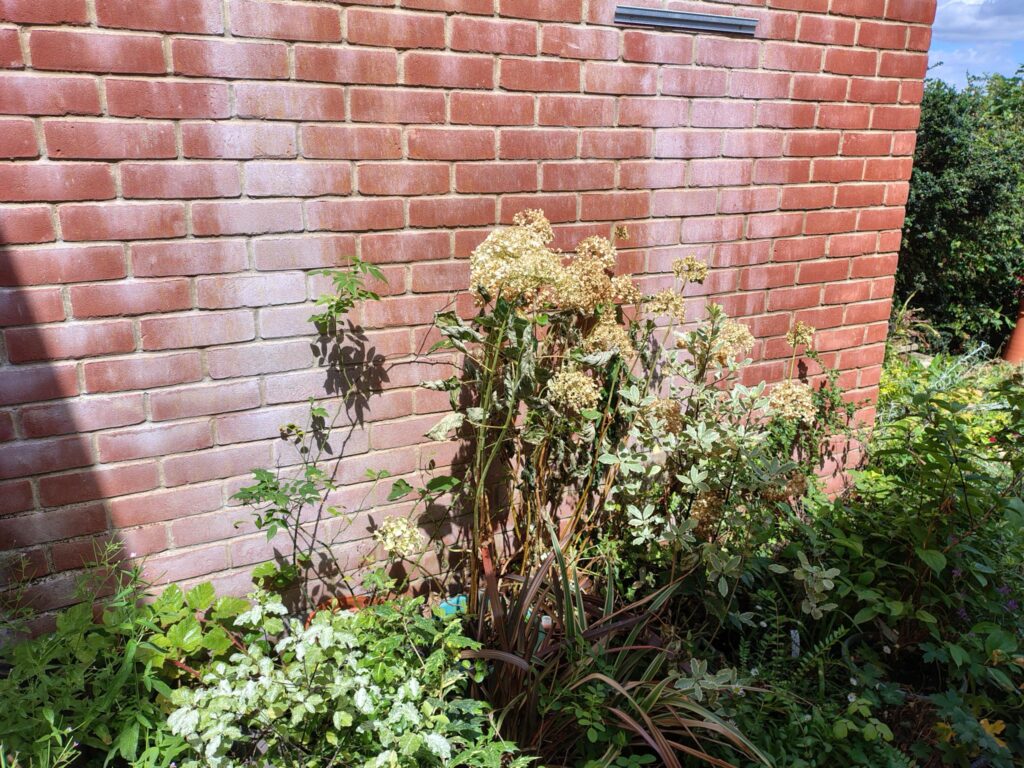
Nearly all the leaves had scorched, the flowers were browning, and I assumed I had lost them. (Please note the Pittosporums front left were still looking fine). I kept watering the pots in a vain hope that maybe not all the leaves were goners. Nope, all fell off. What made it even more galling, was visiting RHS Wisley on 25 July THEIR row of Hydrangea arborescens ‘Strong Annabelle’ still looked fabulous. (Because, whilst in full sun, they are supplied with water via a leaky pipe system at their feet).

I won’t give you all the stats for my areas, but we didn’t get any rain until the last week of August, (when we also got the first hosepipe ban since 1976), and the day temperatures did not get below 30 degrees until well into September. It was only as September progressed that I suddenly realised how extremely dry the air had been all July and August. Night temperatures were generally only reducing to mid-20s, and there was a desiccating breeze too. What we didn’t have was any dew/moisture developing overnight. The farmer not only harvested the oilseed rape in the fields below us weeks early, he also did it at about 4.30am – doing a field a day rather than all at once as usual – to try and maximise any moisture there might have been.
If you listened to Matthew Wilson’s zoom talk at the HPS AGM you will know he mentioned plants going into summer dormancy this year. Not a phrase I was aware of, but I realise that grass does this most dry years – going brown and “dead-looking” util there is some rain to revive it. I had not realised that shrubs like hydrangeas might do the same. And yet, very gradually as the weather cooled to only “unseasonably warm” at the end of August the bare stems put out green buds, that by mid-September unfurled to new leaves: -

This shot shows the variegated Pittosporum tenuifolium ‘Irene Paterson’ and Variegated Ivy Hedera helix ‘Goldchild’ either side of the Hydrangea arborescens ‘Strong Annabelle’ did not scorch or lose their leaves during the summer. As you know, the Pittosporum have smaller more leathery leaves than hydrangea, with a more waxy coating on them – something you could say the ivy has too. The hydrangea have big leaves which have no waxy coating, are very thin in structure, and more “floppy-feeling” than the pittosporum or Ivy. These plants are all in pots, and whilst we do not water the flower garden at all, plants in pots DO get watered. I have long wanted both Hydrangea arborescens ‘Strong Annabelle,’ and Hydrangea paniculata ‘Limelight,’ despite them requiring a more moisture-retentive soil than I have on my chalk hillside.
I had planted a Hydrangea arborescens ‘Strong Annabelle’ in a “hospital bed” two years ago – and when I went down mid-September to check on it, it looked like this: -

Did you spot it? It is still only 35cm or so tall, but it retained its leaves, AND its flower all summer, albeit the flower was going over much earlier than it should have. Opposite it, I planted my Hydrangea paniculata ‘Limelight’ that I had bought in 2021 and nurtured in a pot in the shade util I planted that out three years ago. Here is what it looked like mid-September: -

Again, a pigmy, maybe 45cm high and wide, and retaining all its leaves all summer, but no flowers. In case you were wondering – this is what a Paniculata Hydrangea SHOULD look like, in this case Hydrangea paniculata ‘Dolly’: -

Do you notice what a different colour the leaves are compared to mine, never mind the size and scale of this bush – taller than me, and certainly more than 2m wide. The leaves of both the hydrangeas in the ground in my garden are much more yellowy – and this should have been a warning to me that RHS Wisley has acidic soil, and professional hydration methods. I was captivated by their Hydrangea paniculata ‘Vanilla Fraise’ (‘Renhy’) growing in full sun though – with himself next to it for scale –: -

The completely different climate and soil conditions DID stay in my mind when I visited the Lakeland Collection of Hydrangea at Holehird Gardens above Lake Windermere last September. They have over 200 species and cultivars, which includes a sizeable collection of Paniculata hydrangeas. They had had a National Plant Collection, but after severe weather by 2012 causing many losses, they decided to relinquish National Collection status and concentrate on varieties that would thrive in Lakeland conditions. I have to say that THEIR Vanilla Fraise towered over me by several feet – the hydrangeas were more like multistem trees than shrubs and looked very happy indeed. And here we reach a learning point that I have absorbed over the hot summer, and am wrestling with the implications of now, which can be summed up as ‘plants surviving or thriving.’
I think you could definitely say, based on the evidence of my hydrangeas that whilst they are surviving, by either entering summer dormancy; staying pigmy; and/or not flowering; they are NOT thriving. Either they are miserable, with chlorotic leaves, poor, or no flowers; or look dead whilst they are in summer dormancy, certainly not the magnificent show-stopping specimens they should be. Do I want a garden full of summer dormant or poorly looking plants that are struggling to cope with cold springs, drought, potentially many more frequent heatwaves, above average temperature summers, and very wet winters?
(Imagine a whining tone here) But I particularly wanted the Hydrangea arborescens ‘Strong Annabelle’ after seeing it used by John Brookes at Denmans Garden as a floriferous divider between parts of the garden, rather than having a fence or other barrier: -

I clearly now have to consider not just right plant right place, but also that our climate seems to be exhibiting more extremes more frequently. Do I want a summer dormant garden, or lots of pots that have to be watered with a watering can in hosepipe bans?
Another thing Matthew Wilson said in his talk - that he came back from holiday in July, found his garden going summer dormant and “disengaged” from it. Due to the heat from the last week in June onwards I too disengaged from my garden. Initially because of the extreme heat I disengaged physically as I was unable to be out in the garden except at about 04.00 to do watering, or an hour or two of emergency vegetable garden work. But as it got hotter and hotter for longer and longer I also mentally disengaged, and himself was left to water and undertake any weeding etc that was essential to maintain the vegetables and fruit. Even when it became cooler toward the end of August, the ground was still rock hard, and with hosepipe bans, both the ability to dig or weed into the rock-hard soil was not there, nor was there any point trying to plant anything as it could not be kept watered, very dispiriting. I am still not returned to “proper” gardening. So, this suggests the answer to my question to myself “Do I want a summer dormant garden, or lots of pots that have to be watered with a watering can in hosepipe bans” is NO. Do I want a gravel garden like Beth Chatto’s? (NB These were taken at the beginning of June 2019.


Or the sort of garden that Derek Jarman developed at Dungeoness: -


Would the sort of plants that survive in drought in these gardens cope with the extreme winter wet we have been having – even with the good drainage on our chalk hillside? I discussed this all with my sister in Sheffield and she was extremely vehement that she didn’t want tiny-flowered, silver-leaved sparse planting. Whilst I don’t mind PARTS of the garden looking like Beth Chatto’s gravel garden, I want green in other parts of my garden, I want summer colour through July and August, I want density of foliage. I don’t want poorly-looking wind-twisted sorry specimens like in Derek Jarman’s garden to dominate my garden, I’m thinking particularly of the Cotton Lavender (Santolina Chamaecyparissus), as this year that was one of the few plants that grew extremely well here – it has looked healthy and happy in the un-watered poor chalk soil, flowering well, and setting seed which I have been able to collect and send to the HPS. Here just starting flowering in June: -

Next month, I’ll consider how other plants in my garden fared this summer and ponder more about future-proofing the planting.