

My aim with the planting plan for the Long Border was that the border would peak in interest in September. You may recall it was knitting together better than I expected in its first August after planting, so this month, let us go for a walk round the border in mid-September, and see how it is developing in its first September after planting. We will be walking first along the top edge of the border, turning down the steps at the end of the border with the Bamboo screening the fence with next door, and walk back along the front edge to where we started. (N.B. I was now was describing the long edge of the border with the fern bed/gabion wall to the left as the top edge, and the bottom long edge of the border as the front edge.)
Here we are looking along the top edge of the border. The Phalaris arundinacea ‘Feesey’s Form’ is a good solid lump in the corner, and the yellows of the Perennial Sunflower Helianthus ‘Loddon Gold’ and yellow form of Helenium ‘Helena Mix’ show up well.

Looking back at that third from its further end, you can see the seedheads of Calamagrostis x Acutiflora ‘Karl Foerster’ and Verbena Hastata ‘Blue Spires’ against the Rudbeckia fulgida var. sullivanti ‘Goldsturm’ and Verbena Bonariensis: -
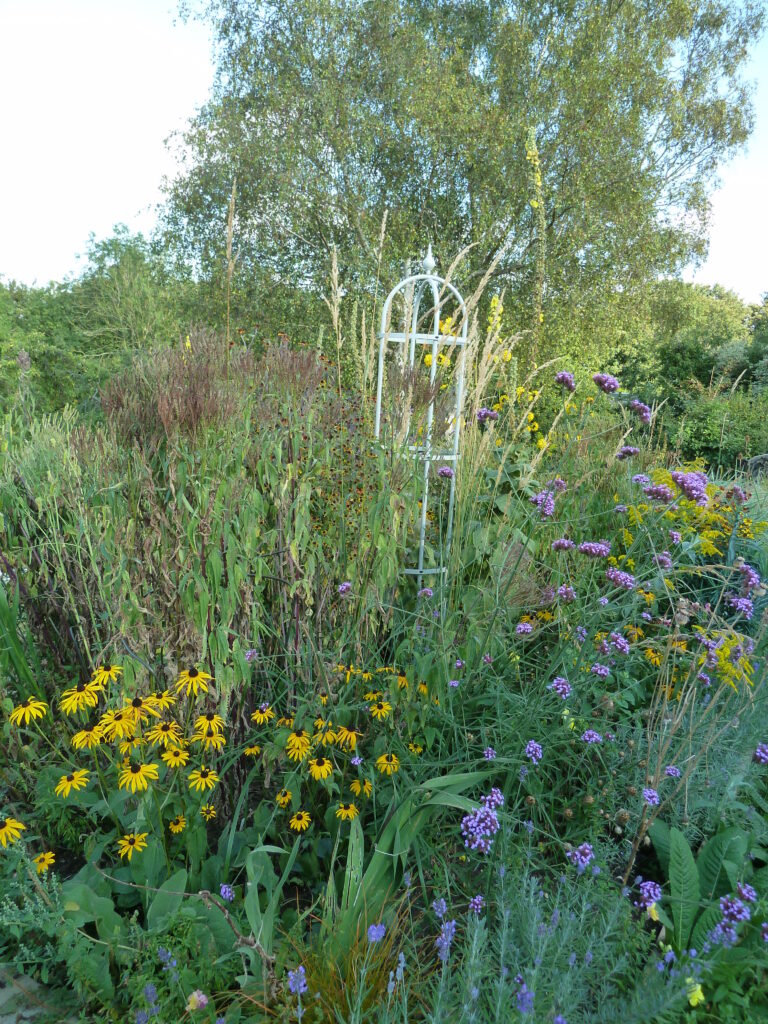
I was pleased with this mix of Verbena Bonariensis and the yellows of the Rudbeckia fulgida var. sullivanti ‘Goldsturm.’ The heft of the Verbena Hastata ‘Blue Spires’ I showed you last month was lasting well in September with the flower spikes now dark seedheads giving interest; with spikes of paler Calamagrostis x Acutiflora ‘Karl Foerster’ seedheads, the Verbascum Olympicum and the Helianthus ‘Loddon Gold’ showing yellow in the background as well. I had hoped for bright yellow and red zingy colours in September, and this seemed to be delivering.
Just slightly further on you can see the utility path between the first and second thirds, with the Rudbeckia fulgida var. sullivanti ‘Goldsturm’ very prominent, and the rusty red/yellow flowers of the Red and Yellow versions of my Helenium ‘Helena Mix’ at the back of this photo (i.e. at the front of the border), and the dark plumes of the Verbena Hastata ‘Blue Spires’ spikes to the right. Some of the purple flowers at the bottom of the photo are the Lavender hedge (Lavendula ‘Hidcote’) still in flower in places – which was quite surprising for September: -

Looking left from that position you can see the very yellow patch of various Rudbekias, Golden Rod, and the Helenium ‘Sahin’s Early Flowerer,’ with the front clump of Phalaris arundinacea ‘Feesey’s Form’ as contrast: -

This shows quite nicely how the different heights of the Rudbekias versus the Heleniums, and varied sizes of the respective daisy flowers give variety visually. The Heleniums with their shorter, tighter, petals seem a more “bumpy” daisy flowerhead compared to the flatter Rudbekias.
Even in the middle third of the border, it’s not all zingy yellows and reds – the more muted pastels that should be more prominent in the “silver” third at the end, are starting to be introduced, and below you can see the Rudbeckia fulgida var. sullivanti ‘Goldsturm’ are flowering well with the pink cosmos behind them, and the Pink flowered Salvia Microphylla ‘Cerro Potosi’ in front.

Looking back at that third, the seedheads of this clump of Calamagrostis x Acutiflora ‘Karl Foerster’ provide a good counterbalance to the daisy flowers of the Rudbeckias: -

Passing along and down the steps to look back through the final “silver” third you can see the dark Gallardia x grandiflora ‘Burgunder’ are mingling well with the Scabiousa ochroleuca, Verbena Bonarensis and the Verbascum Olympicum still in full flower.: -

That angle shows that the Verbascum Olympicum are flopping forward, over the Scabious which makes you realise that so are the Gallardia x grandiflora ‘Burgunder,’ drooping over the Lavender hedge. This was unexpected – as you have already seen our walk along the back of the border shows all these plants standing upright in the first two thirds. As you know, this border is on a slope, and this last third had the largest drop from front to back. The front planks that were containing the border were two planks high (i.e. at least 30cm, whereas from about halfway along there was only one plank holding back the soil. This falling forward of plants in this front third of the border meant that many plants planted in front of these taller plants either struggled to survive/compete, or themselves drooped forward over the front of the border rather than being the bushy shapes they were elsewhere. A definite learning point for the following year that some of the plants in the silver third need staking, even if the same plants growing in the other parts of the border do not.
From the front of the Silver Third you can see the Artemisia behind the Scabiousa ochroleuca and Gallardia x grandiflora ‘Burgunder’ (and the double board in the front of the plants retaining the bed): -

The silver haze of the Artemisia ludoviciana ‘Silver Queen’ behind reminds me of another learning point – I mentioned in previous months how unexpectedly huge this plant grew, and what I hadn’t realised was that over the next year its huge woody stems sprawled in all directions – smothering all the planting in its vicinity – especially many Echinacea ‘White Swan’ and ‘Green Twister.’ Too late for them, I learned I needed to prune the Artemisia back almost to knee height for it to bush out in its growth.
Turning to our left the view shows where the double board gradually dips and vanishes halfway along the view:-

This shows the Gallardia Aristata ‘Goblin’ past the group of Cosmos bipinnatusis staying in a more bushy shape as the slope of the bed is not so extreme, and that the Cosmos are also standing tall behind the Heuchera ‘Marmalade,’ and the White Penstemon from the Harlequin Series. I would always recommend Cosmos as they are and easy annual to grow from seed (and the seed is viable for many years so you can sow part of a packet and keep the rest for the following year); they flower until the frosts, and the foliage is lovely and filmy too. I was keen following this success to try the Cosmos sulfureus a shorter, yellow cosmos, which fortunately the Hardy Plant Society Seed List had that year, and I was able to secure a packet of to sow the following year for the border.
Looking more closely you can see the difference in flower shape between the Cosmos and Verbena Bonariensis as they mingle together set off by the silver haze of the Artemisia ludoviciana ‘Silver Queen’ behind: -

You may notice to the left middle of that photo one solitary Echinaea flower. I was really surprised that by mid-September all the Echinacea had stopped flowering.
Further along the middle section: -

I’ve tried to get an arty shot of this middle section showing the grasses seedheads in the golden September light: -

I am pleased with how in both this and the photo above you can clearly see tall plants near the Obelisk, but they do not obscure the Obelisks, giving variety of structure and texture to the eye. Standing at the front of the utility path between the middle and first thirds, the view is a haze of reds and yellows through the Verbena Bonariensis: -

You can see the dark seedheads of the Verbena Hastata ‘Blue Spires’ at the back that I showed you from the other end of that path looking forwards earlier. Also, the comparatively tiny red flowers of the Salvia Microphylla ‘Royal Bumble’ in front. This is another plant that flowers continuously from June to the frosts, and another I highly recommend together with the Pink flowered Salvia Microphylla ‘Cerro Potosi’ I showed you earlier. (Take cuttings of these Salvias, which root easily, and keep them in a greenhouse/cold frame over winter as insurance as they don’t like cold and wet winters, especially if you have heavy soil.)
Looking more generally at the front of the border in the Autumn light it clearly shows the “sag” of the front of the silver third of the border, as artistic and beautiful as it is here: -

Looking at the front of the first third in October you can see all the colour: -

I am particularly pleased with the grading of heights in this patch, with the Gallardia Aristata ‘Goblin’ and the Penstemons from the Harlequin Series flowering in front, the Rudbeckia fulgida var. sullivanti ‘Goldsturm’ behind and the higher Heleniums, and Helianthus ‘Loddon Gold.’ Looking at this part from the front corner of the border you can definitely see the lavender hedge (Lavendula ‘Hidcote’) is still flowering. You also note the swordlike leaves of the gladioli standing tall, and that the Verbena Bonariensis is upright – this is the part of the border with the shallowest drop: -

By the end of October, the border now looked like this: -


These show how much colour was still very evident at the end of October from the Gallardia x grandiflora ‘Burgunder,’ Verbena Bonariensis, Cosmos, as well as the seedheads giving interest.
Next month, right plant right place or triumph of hope over experience (i.e. me trying to grow hydrangeas….)