

This month, some wonderful late Autumn flowering salvias in the garden, and my look back at our veg production this year.
The tomatoes went into the polytunnel last week of May: -

Unlike last year, this was a good tomato year – they loved the warmth and the sunshine, and with the mild autumn were still ripening and producing a great amount of tasty fruit throughout October, though with the severe cold spell at the beginning of November I had to remove all the remaining fruit from the vines and have been ripening them inside ever since. We may even have some just-ripened tomatoes at Christmas. Here firstly the vines after harvest, and the harvest on 16 October: -


Continuing the undercover crops, we had a continuous harvest over a long period from our three cucumber plants in my greenhouse, feeding them when we fed our tomatoes meant we never had too many cucumbers at once to keep up with eating or pickling. One was La Diva, a mini or lunch box size cucumber, and two were Lemon Crystal – both varieties I would recommend. We also were given some chilli plants by our neighbour, which have also produced a good crop of fiery chillies – loving the weather we had.
As you might expect the courgettes also much preferred this weather to last year, the slugs did not decimate them this time, and we had them planted out during May: -

And were still harvesting from the climbing tromboni courgettes till almost the end of October, ceremoniously eating the last fresh courgette on 31 October. As you can see, the bush courgettes got mildew in the dry weather, though the climbing ones escaped that – here early-September: -

I seem not to have taken a picture of all the varieties of courgette we have grown this year – here is a sink full from late July: -

As you can see one of the tromboni got away from me!! We also grew yellow courgettes (constantly less prolific than green ones), and a round one called piccolo which we were very pleased with. The packet said you could leave them till they were about 15cm long (oval rather than round at that point) and stuff them. These were GREAT for the two of us, with soft skin and firm flesh like courgette, but stuffable like marrow. We will be growing these again.
You may have noticed the leafy looking bed to the left of the climbing courgettes in the picture before last – these were the chard. Here they were planted out in May: -

Now, this was already more than 8 weeks since we had had any rain, and whilst we did not have a hosepipe ban here, and were able to water these, the hot dry windy weather we consistently had meant that they quickly bolted.

We have been able to harvest some leaves from them, but normally they overwinter and THEN go to seed in their second season (being biennial), so we get leaves next spring to tide us over part of the hungry gap. So, we will not have this option next year. The kales were also planted out in May: -

Whilst they have not bolted, they are truly puny in size, mainly because they were overwhelmed by flea beetle. The infestation was the worst I’ve seen. We managed to bar the cabbage white butterflies from the winter greens tunnel, but the flea beetle just hop through the mesh. They took till the autumn to start fighting back, and currently the Cavelo Nero have maybe six leaves on each plant…

The same thing happened to our nasturtiums – being from the brassica family - they were tattered lace leaves all summer, and only started producing flowers and leaves we could harvest in late September – here in Oct: -

Note the canes – these are climbing nasturtiums and should have been 2m tall – but are just covering the ground at the end of the season.
The onion seedlings our neighbour gave us were planted in the tunnel too. They have reached golf ball size, so look more like shallots! We also tried celeriac, which we have yet to harvest, so will let you know later on how that went.
A success for us was the mini sweetcorn. Being a grass it seemed better at coping. with the conditions, and also being wind pollinated, set fruit well in the hot dry wind we had: -
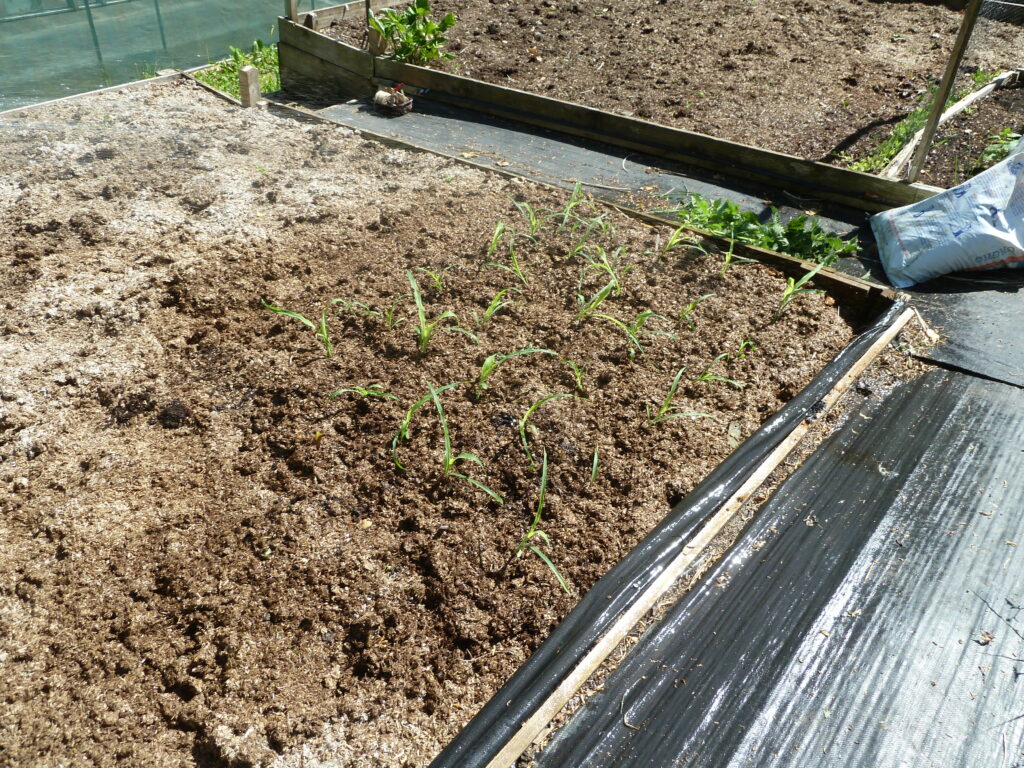
Another crop I seem not to have photographed when I harvested it. We got better this year at harvesting the corns at a mini size, and they tasted wonderful. I can’t say they particularly costed in financially, as we only got 3-4 mini corns per plant, but the taste, and saving of air miles were definitely worth it. Next to the corn we planted leeks: -

These seem to have survived the rigours of the summer and will provide us with a winter crop.
The crop I had the most trouble with were our climbing beans, both French and runner. They germinated well, but whilst outside hardening off before planting, we had particularly gusty strong winds which snapped most of the plants at some point on their stem, and whilst I tried to plant them out, most did not survive this. By that point it was so late in the season, I had to resort to BUYING plants to plug the gaps. (Bows head in shame). So, we had fewer beans, and they were not the mix of red and white flowering runners that I usually sow to spread my bets for whether it will be a hot summer or not. They struggled to flower and set fruit in the hot desiccating wind, despite being sprayed with water regularly. I was thinking I would have to report to you that my usually reliable Cosse de Violette climbing French bean had not produced properly, but once the weather changed at the end of August, and we had some less hot weather they began to flower better and set beans. I have had enough harvest from all of them combined to eat fresh all summer; and to pickle for the year; but not to blanch and freeze for the winter or give to neighbours. They continued to provide us with fresh beans to eat until 19 October, when we ceremonially ate the last ones with our Sunday dinner. Strangely, though not producing flowers or beans, many of the runners have made very healthy-looking foliage late in the season – here in late October: -

A learning point for me from this is to leave sowing the beans even later than I usually do – at least 3rd week in May, rather than at the beginning of May – so they are only just germinated, and possibly need less hardening off in early June thereby reducing the risk of top-growth being snapped off by the winds.
So, how did I think the experiment with the seed compost as a thin layer on top of normal peat free multi-purpose compost that I told you about in my May article went? I would say it worked well. The seeds all germinated well and grew on (without becoming etiolated) to a sensible size for me to prick them out without having to feed them, so I will definitely be doing that again next year. Looking at the colour in the late October garden I would have to say, the Michaelmas Daisy that was here when we arrived was looking good and was a magnet for bees and hoverflies:

Some years it looks white-flowered, but as you can see, this year it’s a pale mauve. Also looking great were four late-flowering Salvias. Three of them are the small-leaved types that seem more hardy here than some of their larger-leaved cousins – Salvia microphylla ‘Red Bumble’: -

Salvia mycrophylla ‘Cerro Potossi’: -

Salvia ‘Nachtvlinder’: -

After surviving many years, I lost my Salvia uliginosa (Bog Sage) the winter before last, so bought a new plant this year, so fingers crossed it makes it through this winter: -

Next month I shall start to tell you about putting in my long border in front of the fern bed. All that remains it for me to wish you all a Merry Christmas and send you Season’s Greetings.