

That “meadow” look. How easy is it to achieve or maintain? This month and next I shall think about intentionally creating a meadow in the garden. Obviously the first questions to ask are how big an area will it cover; is it in full sun/shade; do I want to be able to walk through it/round it; how much of the year do I want it to be of interest. Another big question for me is should it have grass in the mix? Now, that’s an interesting one – when is a “meadow” a meadow? The wildflower meadows I was describing last month, where I left my grass to grow and the wildflowers “magically” appeared in it is how I traditionally think of a meadow – I suppose, a hay meadow is my archetype. Here’s a largescale example: -


This month I shall consider making a meadow including grass in your planting scheme, and next month consider how to make a meadow that does not.
Grass, particularly the sort of strains that are sown for lawns are extremely tough, adaptable, and thuggish plants – on my chalk hillside area the grass is a more wispy natural poor version, but up near the house there is the remnants of an actual lawn, and THAT grass is much denser in growth, and holds back/outcompetes Ground Elder! If you look at the two photos above, the overriding plants you see (apart from grass!) are Ox-Eye Daisy (Leucanthemum vulgare) and Creeping Buttercup (Ranunculus repens). Both are very tough and will hold their own in a grassy meadow – indeed the Ox-Eye Daisies are in fabulous flower on verges of roads through May and June, even very sloping ones; or, as my sister reported from Chesterfield just before spring bank holiday, on the central reservation of dual carriageway roads.
As all gardeners know if you leave grass to grow it will go to seed, and that will scatter and grow – through my borders and into cracks in the concrete paths here. So, you have two options – work with the sward you have and perhaps use Yellow Rattle (Rhininthus minor) to reduce its vigour; or start with a piece of ground that is lawn-free. I know someone who sowed a wildflower seed mix onto a border area they wanted to turn into a wildflower meadow, and they assumed the grass would come by itself (and it did, outcompeting the wildflowers by the second year, such that few annuals came back the following year.
Let us start by considering the (possibly) easier option, of starting with a lawned/grassed area, and creating either bare patches within it for seed sowing, or for putting in plugs of plants or bulbs. In this garden it is tempting to allocate the scrubby grass under fruit trees or shrubs for this purpose, but this presents its own considerations. Two words – dry shade. In the winter, when the trees have lost their leaves, there is more light and moisture, and depending on the weather in spring, this may last until mid-May when the tree canopy closes over. Obviously not this year, as we had no rain from March onwards and the ground looked like this by early May: -

However, in other years, you have the opportunity to put into this space many “woodland” species of plants and bulbs, which will flower before the canopy gets too dense, and then go dormant during the summer. In my orchard I have Snowdrops and Aconites for the winter; daffodils and crocus for early spring; and as you saw last month, Cow Parsley (Anthriscus sylvestris) under the trees in April/May before the leaves get too dense. I also have Aquilegia planted; Cowslips (Primula veris); Camassia; Fritillaria; and Iris foetidus. Other plants that like dappled shade are: -
English bluebells (Hyacinthoides non-scripta): -

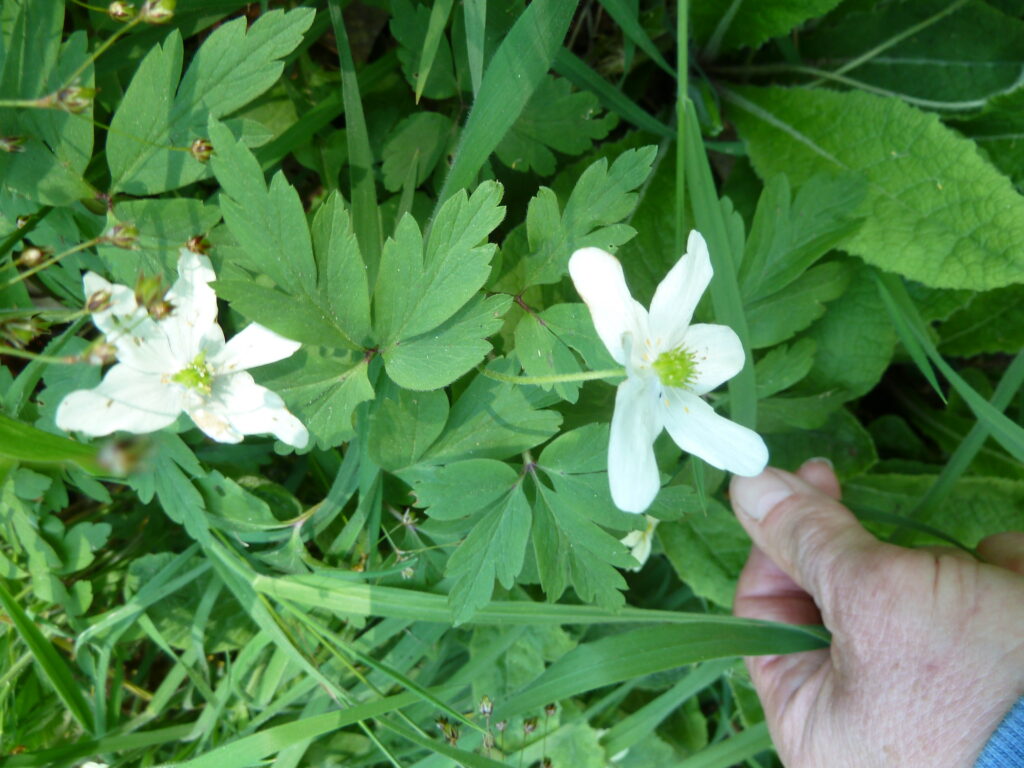
Wood anemones (Anenome nemorosa): -
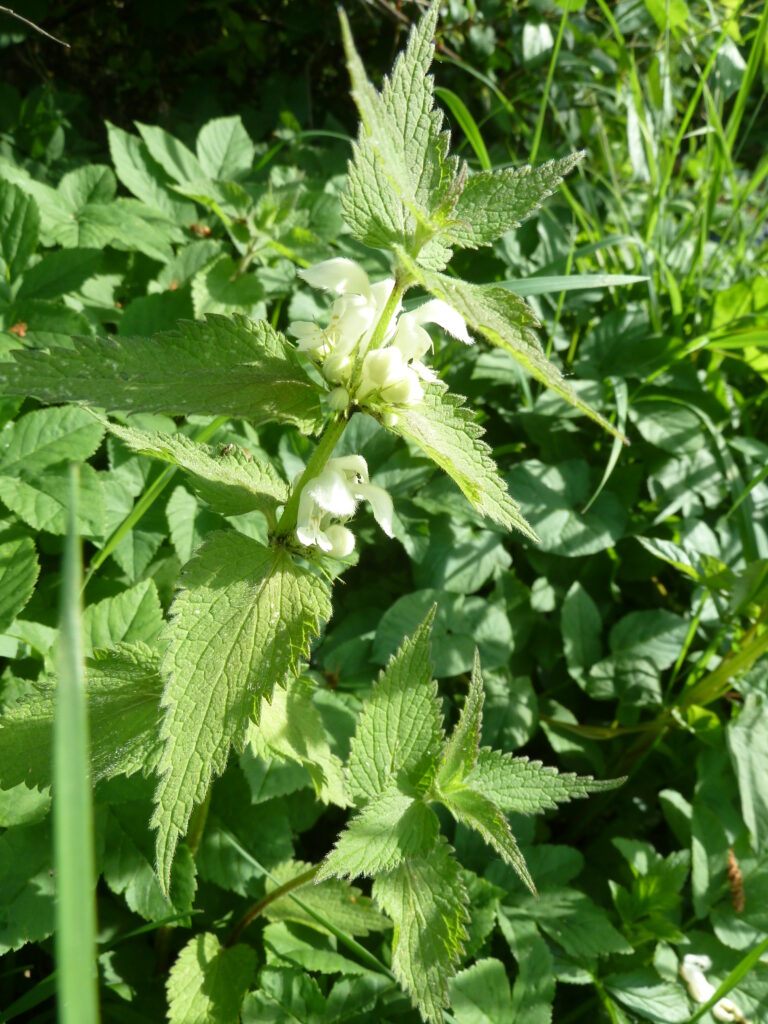
Many members of the deadnettle family – such as White Dead Nettle (Lamium album), and the Yellow Archangel (Lamium galeobdolon): -

Primroses (Primula vulgaris): -

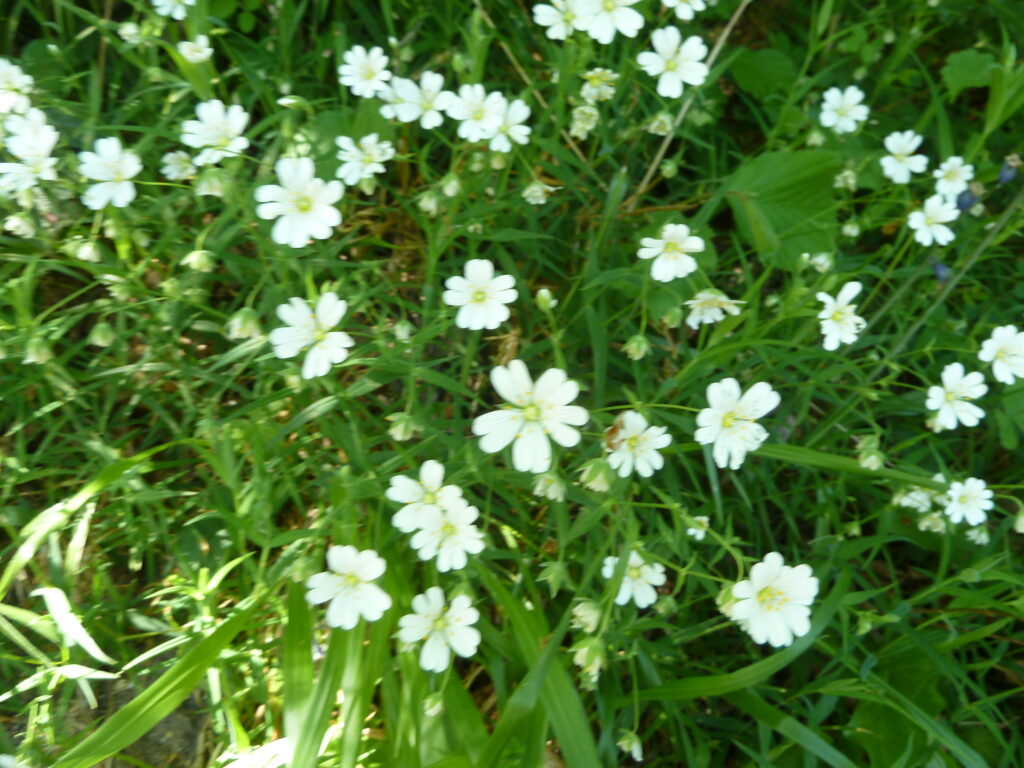
Greater Stitchwort (Stellaria holostea): -
Pink or red campion (Silene dioica)
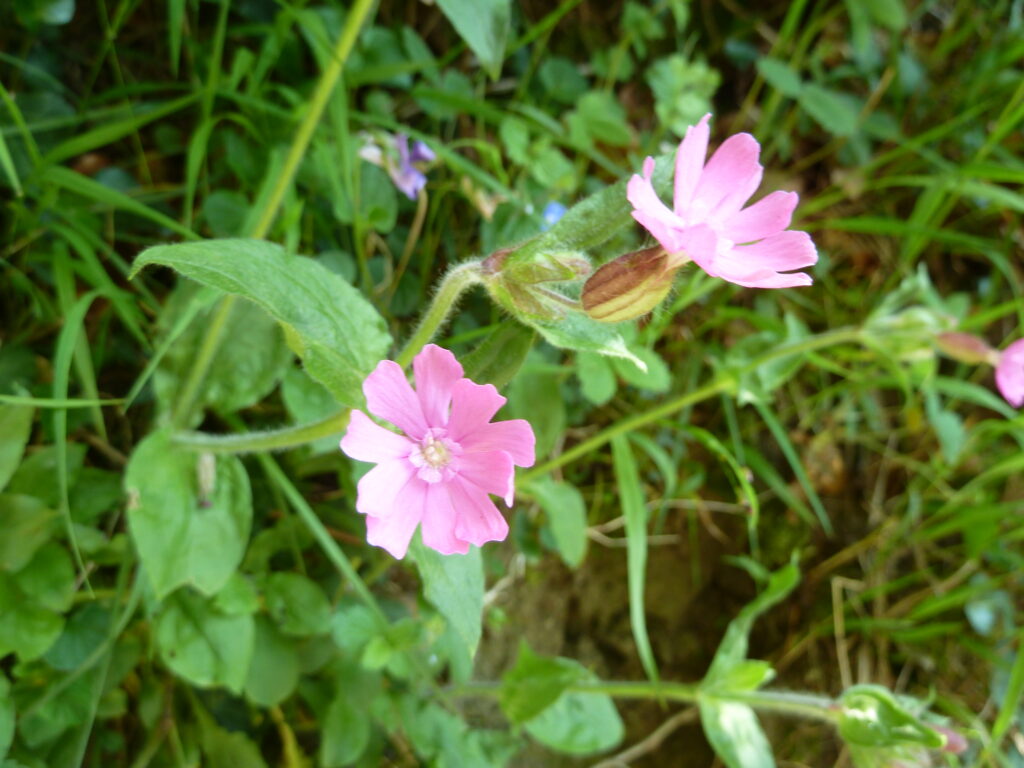
This latter can also cope with less shaded conditions well, as can the White Deadnettle – which seeded itself into my long border round the skirt of tall perennials without any help from me. In the same border I planted some of my Bladder Campion (Silene vulgaris) which flourishes in grass, and in sun: -

You may have noticed that many of these plants are bulbs, which are more able to compete with lusher grass. Cow Parsley (Anthriscus sylvestris) is another tough plant that can outcompete lush grass, as can Geranium Endressii. However, this brings us on to management of the grass. Here in the orchard, with the woodland/early spring plants all now dormant, the bulb leaves die down naturally by June, and the Aquilegias and Cow Parsley have gone over, allowing the grass to be cut around the time of the June drop of the apples. This can be then cut again before the windfalls start to drop. But in sunnier areas where there are later-flowering plants, such as the Geranium Endressii, or Geranium molle, or where I am leaving the seedheads of e.g. Cowslips or orchids to ripen, the grass needs to be left until late August at least until the grass is cut to allow the seeds to ripen and fall. Here G. Endressi late May, with the Cowslip Seedheads just beginning to form: -

So, if your chosen meadow area is in sun, you will need to consider when you want your meadow to flower, and if you want the plants to set seed, which will determine when and how the area can be cut. As I said last month, some low-growing plants flower or leaves escape the mowers blades if you set them higher, but if you have left grass to grow throughout May, it will be tall. Later flowering plants that are still “technically” wildflowers include Pilosella aurantiaca (Fox and Cubs) and other hawkbits. First Fox and cubs: -

Then some Dactylorhiza fuschii (Common Spotted Orchids) with Rough Hawkbit (Leontodon hispidus) behind in late June: -
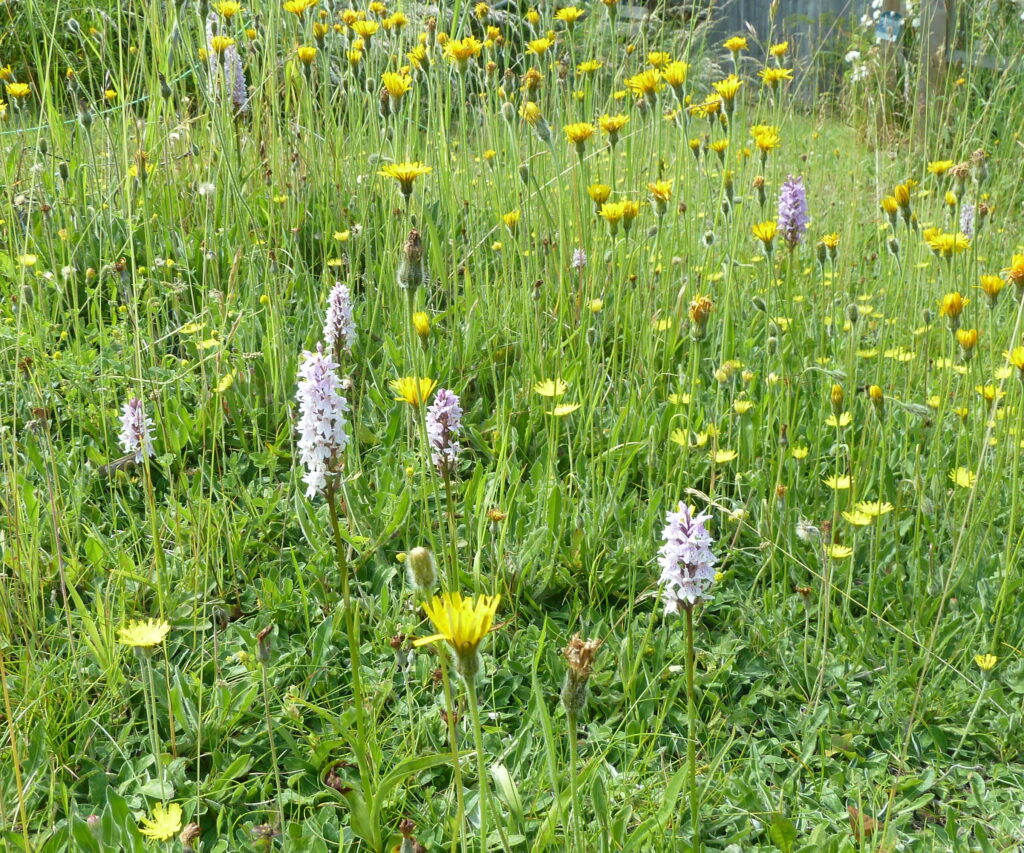
Other yellow flowers that grow through the grass here include ragwort – which the cinnabar moth caterpillars feed on. (Shading into cultivated flowers as a tall yellow is Solidago or Golden Rod, which I can attest can seed itself into ANYTHING in this garden!).
If you love the umbels, you could redesignate that pernicious weed Ground Elder (Aegopodium podagraria) as it was introduced for its ornamental white umbel flowers!! As you can see here: -

(Definitely DON’T introduce it to your garden intentionally, please.) Far less invasive would be Daucus carota or Wild Carrot; or an annual such as Ammi majus would give the same effect. I have struggled with the cultivated version of Anthriscus sylvestris ‘Ravenswing,’ - despite the wild Cow Parsley working well – it’s too hot, sunny, and dry here for. Here Euphorbias seed themselves around freely – especially the Cyprus spurge (Euphorbia cyparissias) which loves being on the dry sunny grass, and if left can make quite impactful clumps: -

Another impactful plant that loves chalk is Vipers bugloss (Echium vulgare): -

Other more impactful plants include Digitalis purpurea - Fox gloves. Now I know this is on the edge of the woody area, but they do cope in more sunshine too: -

Both of these being biennials, the challenge is not to mow the leafy floret they make in the first year to smithereens so that they get to put up their flower spikes in year two. A very high setting on our mower generally allows them to cope (and Teasels too).
Other more impactful options include White Comfrey (Symphytum orientale), which can spread over a large area, even through grass: -

Another impactful wildflower is Green Alkanet (Pentaglottis sempervirens) – which here can not only grow through grass, but also ground elder, bindweed and brambles. It is beloved of bees, can grow in London clay as well as my chalk, and get to a goodly size here: -
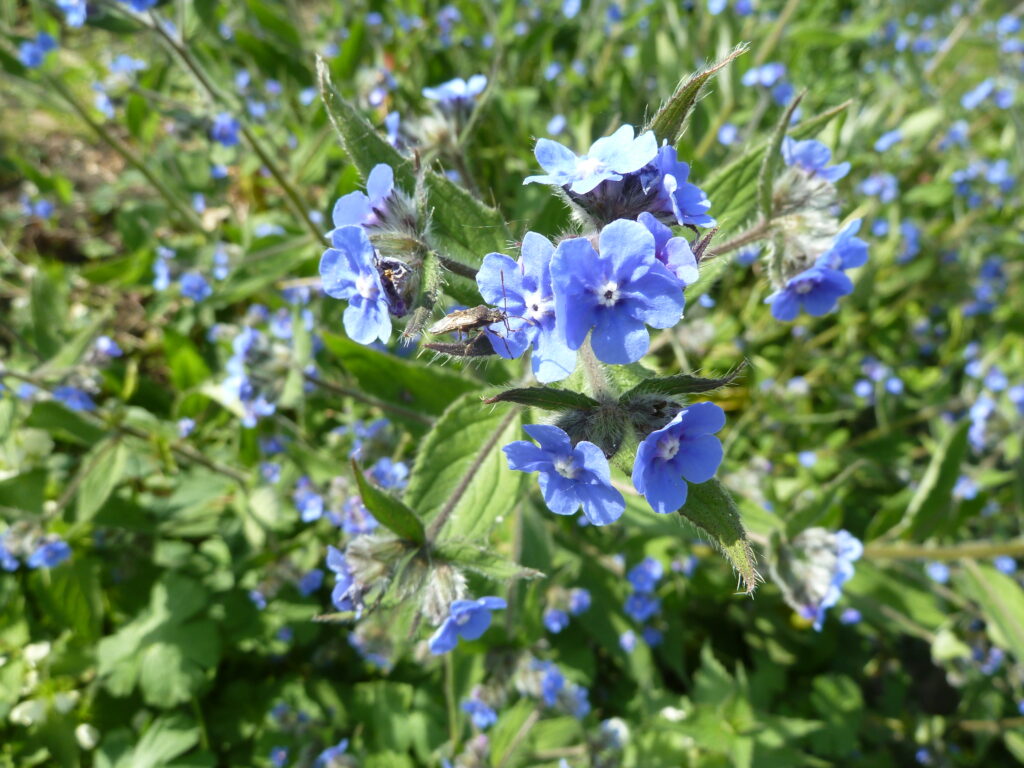
These latter two plants can be cut to the ground as the flowers start to fade (or mown with the grass) and will produce new fresh leaves and flowers later in the year. The leaves and flower spikes of both comfrey and alkanet are valuable additions to the compost bin as they are deeply rooted and bring up nutrients from subsoils. I cut the leaves and bury them when I am planting runner beans or courgettes at the beginning of June as they produce nutritious green matter for the roots of both of these crops.
I have just scratched the surface of meadow-style planting here – concentrating on some of the plants I grow here, in grass. There are many more options, as well as starting without grass in the first place. Next month I consider how you might do this, and how this widens the planting options you might have.
Sheila May