

Before returning to the plant list for my new Long Border, I have to mention May’s challenging weather for gardening. I struggled in the first 20 days in May as the night temperatures fell to close to freezing, or frost-levels each night, so plants grown from seed could not be hardened off, and the greenhouse got fuller and fuller. In desperation we moved the Winter Greens (4 sorts of kale) to the unheated polytunnel under fleece to give space for pricking out the Chards (3 sorts) and Perpetual Spinach. We then had to move the Chard and Perpetual Spinach down there too to allow me to prick out the tomatoes. The roses didn’t seem to mind the weather and were a mass of buds from the second week of May. I’ve seen many photos from others’ gardens round the country to suggest they too have had a great early rose season. Here the species Roses came out mid-May, and Rosa ‘Rambling Rector’ was in full flower by the third week in May.
Rosa ‘William Lobb’ with Rosa FJ Grootendorst, and R Pink Grootendorst behind: -
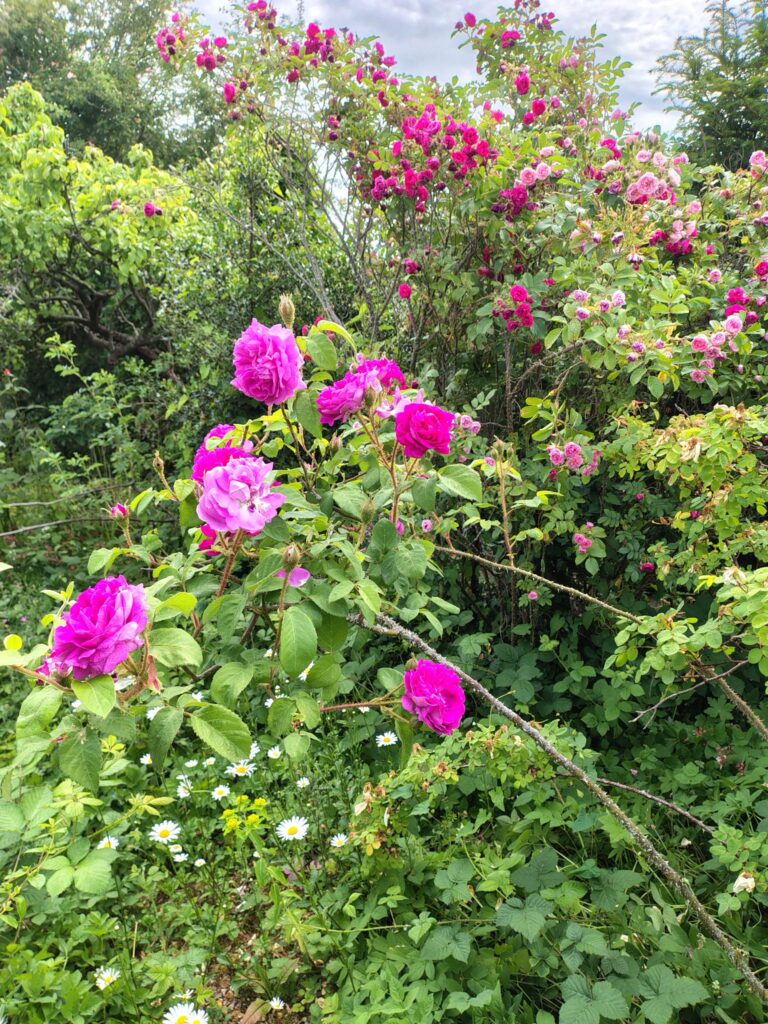
Rosa Burnett, the Double Scotch Burnett: -

Two ramblers – Rosa ‘Albertine’ close to, and Rosa ‘Rambling Rector’ in the distance.

Eventually I planted out the Winter Greens into their tunnel despite the colder nights and had to plant out the chard so that himself could wash out the polytunnel and disinfect the trays and pots for the tomatoes. Then of course we went from that to HEATWAVE. The scent from the roses was amazingly strong, and the colours from all the roses has been wonderful. All our roses are/have been out by the last week in May, much earlier than usual for some of them, and all extremely floriferous. This was one of the few years that the Rosa ‘Lavender Lassie’ was out at the same time as the Geranium ‘Johnson’s Blue’: --
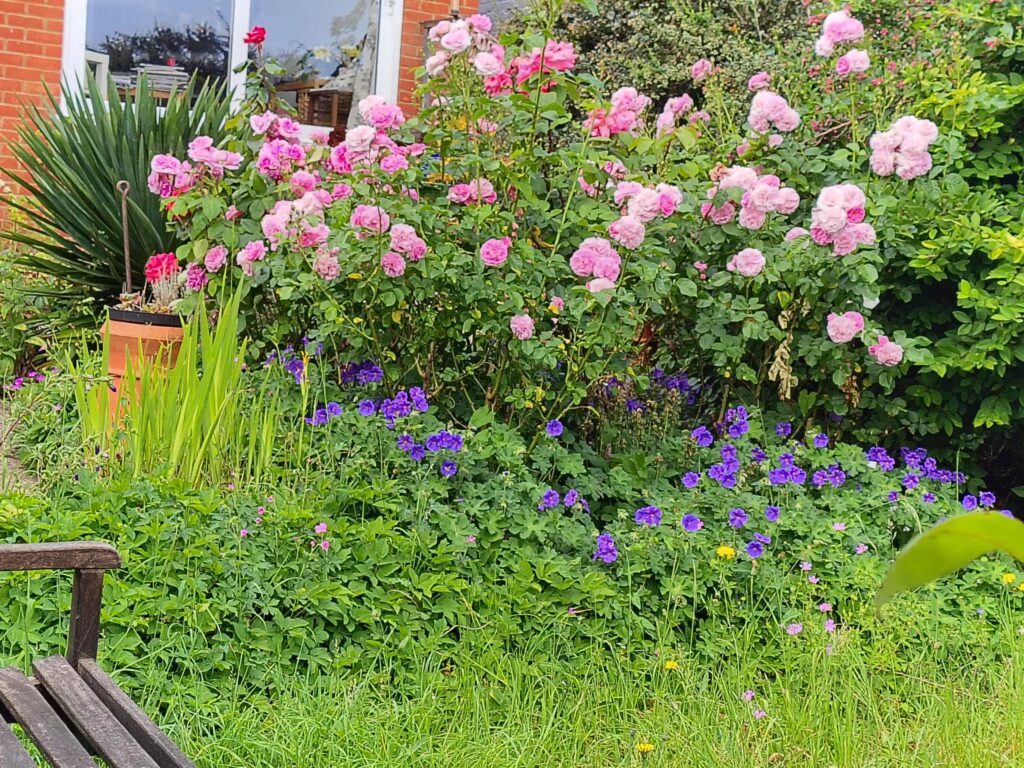
Even the Philadelphus had flowered by the end of May, and the Lonicera periclymenum ‘High Scentsation’: -

In the south we had heatwave for a whole week, which meant that five of these days were well over 30 degrees, and the nights were definitely over 20 degrees. For the first time ever, we had to spray the tomatoes against blight whilst they were still growing on in their pricked-out pots, AND in May. Whilst himself can cope with temperatures in the 30’s, I cannot garden in such conditions, so apart from working for a couple of hours before 09.00 each day, mainly watering, I stayed inside the rest of that time, so we have been dashing to catch up ever since, struggling in ‘only’ late 20 degrees of heat to pot up all the tomatoes into their final pots, plant out the sweetcorn, Leeks and bush courgettes. Here you can see the R. ‘Rambling Rector’ closer up from the vegetable garden side, with the sweetcorn bottom left, and the leeks bottom right of the picture: -

The scent from this one rose fills the entire vegetable garden, and all the way up to the Long Border. Wonderful. For completeness, here are the tomatoes planted in the polytunnel – you can see that whilst he has washed the inside of the polytunnel, only some of the outside has been completed: -

Returning to the development of the Long Border here, and the huge mail order for the remainder of the planting for this border. This was a new experience for me, as I usually either propagate my own plants (or family or friends’ plants) by cutting, seed or division, but as himself wanted this border to look different from the rest of the garden, and with a big birthday coming up I could ask for money towards this plant order for my presents. I had determined that whilst I was aiming for a border that had later summer colour, I wanted it to be of interest from May onwards, so planned to include a few grasses, annuals like Love-in-the-Mist, as well as the late summer Hardy Perennials such as Rudbeckias, Helenium’s, Echinaceas, Verbenas. I also wanted plants with late flowering spike-shapes to cut through all the flatter daisy-like shaped flowering Hardy Perennials.
You have already seen the Lavandula ‘Hidcote’ hedge arriving as small plugs. This sort of through-the-mail plant is something I AM used to as I used to buy tiny bedding plants in even smaller plugs in bulk and grow them on to garden-ready stage but I had no experience of wholesale bare-root plant buying. So, it was quite alarming to receive comparatively small boxes, full of plastic bags. Below is what 40 bareroot Rudbeckia ‘Goldsturm’ looks like: -

Untangled, they looked like this: -

Now, here’s the thing. Yes, I can see there is a shoot at the top and being an herbaceous perennial I assume they go slightly under the surface, but I’ve never grown Rudbeckias before. The roots are LONG. Should they go straight down in a deep hole, should they go wide and shallow like an Eremurus, or some permutation between these two extremes? If you buy a potted plant you plant the whole pot-ball, possibly teasing the roots at the edge out a bit. This is not the sort of information amateur gardeners can find in books I discovered.
Obviously, they were very dry, so needed rehydrating. I plunged them all in big deep pots of multipurpose, watered them, and sat the pots in trays. When I came to plant them I tried very hard not to plant them with their roots coming back up at the bottom of the planting hole, and to fluff the rootball out somewhat, with fingers crossed that was the right decision! These were the “backbone” plant of the Long Border, as I wanted to plant them in all three sections, in “drifts” front to back of the border. In practice this meant planting them in a V formation, with the plants staggered 45cm apart to make a wide ribbon. The first two thirds had a V, or an inverted V so they looked slightly different running diagonally either side of the obelisk. The furthest third only had the diagonal stripe on the first side of the obelisk, and I planted Mixed Pyrethrum Tanacetum in a stripe on the other side. These are June-flowering and pastel in colour.
Just to remind you, this is what the Long Border looked like: -

Fortunately, not all the plants came bareroot, and these Echinacea ‘Green Twister’ which were also for the “Cool” third, came in 9cm pots – more like I was used to: -

Here, flowering in the border in August: -

Also arriving in pots were two types of grasses – three Miscanthus sinensis ‘Morning Light’ and six of my favourite grass – Calamagrostis x Acutiflora ‘Karl Foerster’: -

I planted the latter in wavy lines of three plants in the first two thirds of the border, either side of the utility path across it, so that the upright nature of the grasses would really stand out. Here it is at the very end of September in the middle of a border, its stiff seedheads give drama all winter too: -

Other bare-root plants I received were Veronicastrum ‘Cupid;’ Alstromeria aurea, both ‘Lutea’ and ‘Orange King;’ Some Red-hot pokers (Knipfofia ‘Ice Queen’) as he always liked the varieties flowering in October when we visited Hilliers Arboretum; Japanese Anemones Anemone japonica ‘September’s Charm’ and Anenome hyb. ‘Pamina;’ some perennial sunflowers - Heliopsis scabra ‘Summer Sun;’ Echinacea ‘Butterfly Mix;’ and Helenium ‘Sahin’s Early Flowerer.’ I also got some Helenium ‘Helena Mix’ as jumbo plug plants.
Quiz time – which bareroots belong to which plant?:-


Answers at the end of the article!
Other plants that came as jumbo plugs included more Rudbeckia - ‘Green Wizard’; and ‘Prairie Glow’; Two sorts of Gallardia to plant at the front of the border, in between the groups of Penstemons I mentioned last month - Gallardia aristata ‘Kobold’ and Gallardia ‘Burgunder’; a beautiful pale yellow Scabious Scabiosa ochroleuca; three types of Verbena Hastata ‘Blue Spires’, ‘Pink Spires’, ‘White Spires’ to beef up the spikier shaped plants; and OBVIOUSLY Verbena bonariensis – can’t have a late summer border without it!
More spike-shaped plants included Veronica spicata ‘Rolfuchs’ and Veronica virginicum ‘alba.’ I also fell for some Carex testata ‘Prairie Fire.’
I might have got a bit carried away with the plant catalogues. If they didn’t come in a pot, I had to get the plants into holding pots at once to keep them hydrated and protected from frost in February until I came to placing/planting them out. Here are some of them in a holding position: -

My thinking was to plant them quite densely as these tiny plants, and as they grew, split, and lift them in a couple of years as you would normally do with herbaceous perennials and make a border on the other side of the path that mirrored the long border but was narrower/shorter.
I’ll show you the planting out and how it developed in the first-year next month. I’ll finish with some more flowers from my garden in late May. I am so glad I took these photos as the downpours and strong 35mph winds from first few days of June have stripped all the petals from the roses: -
This Rosa ‘Wendy Cussons’ hangs over the path at eye level: -

Here is R. Albertine from the other angle showing the Red Valerian (Centranthus ruber) and Salvia Officionalis at its feet, and the self-sown Oxeye Daisies (Leucanthemum vulgare): -

The Common Spotted Orchid (Dactylorhiza fuchsia) was also flowering early: -

Quiz answers on the bare-root pictures: -
First Alstromeria aurea Lutea. Second Anenome hyb. ‘Pamina.’ Third Helenium ‘Sahin’s Early Flowerer. Fourth Knipfofia ‘Ice Queen.’
Sheila May