

What a difference the longer days make to the feel of the weather in April. We had easterly or northerly wind direction most of the time, and much of that was at least 25mph, and sometimes up to 35 0r 40mph, so the temperatures were depressed, and the cuckoo didn’t reappear until almost the end of the month. Fortunately, the flora seemed not to notice, and both the Bluebells and the Rhododendrons were flowering early this month. We went to walk through a local Bluebell Wood on 16 April, and the bluebells were just about to go over – the Beech leaves were getting much bigger daily: -
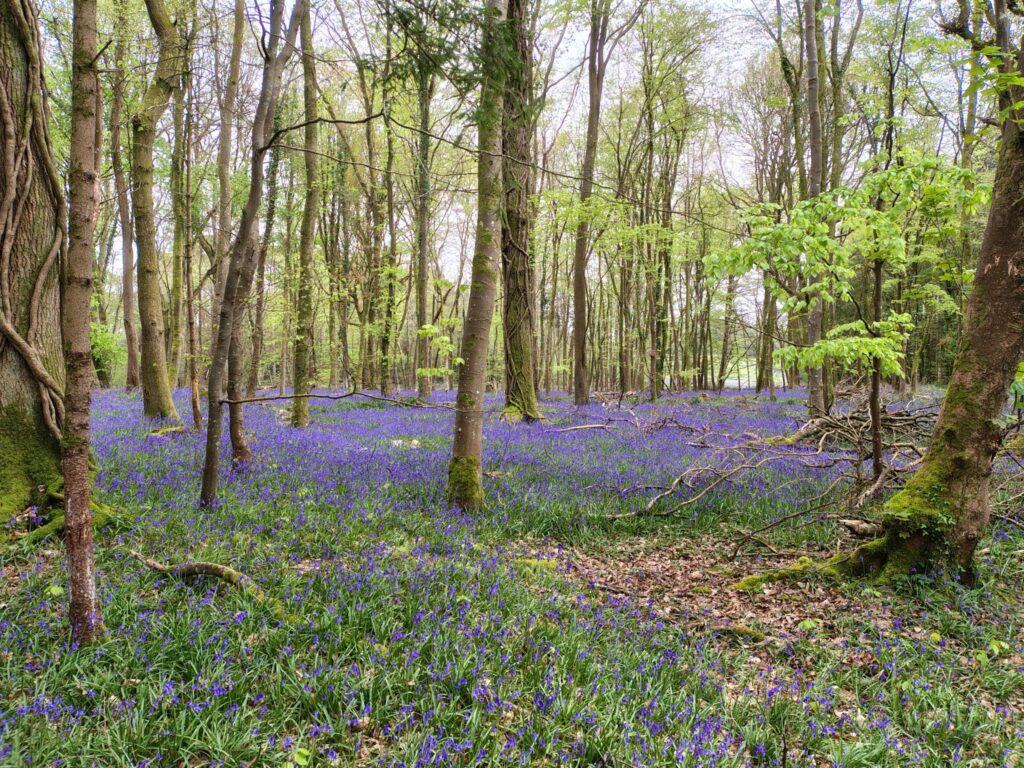

Hyacinthoides Non Scripta (English Bluebells) are such a vivid blue, and when the sun came out briefly, warm enough for their scent to rise to us too. These shots really remind me how insipid the blue of the Spanish Bluebells (Hyacinthoides Hispanica) in my garden is in comparison.
Bowood Woodland Garden near Calne opened on 6 April, rather than mid-April, and when we visited on 21 April (all bundled up in winter clothes against the stiff north wind), the English Bluebells there were looking magnificent still, as well as the Rhododendrons, AND there were still many Magnolias out, a lovely sight. We’ve never been when that has been the case!

Returning to the beginning of December 2020 and the next stage in the creation of the Long Border, we laid out the paths across the bed (utility for access for me), and then concreted them in: -


These two photos should show that I was breaking up the ground in the bed, and gradually adding back in the chalk topsoil we’d removed from the hillside to flatten the ground for the gabion wall/fern bed – here are two further shots to show my efforts there, and the final “pile” I was reclaiming it from:-


Do you notice the dimpled ground behind me? After all that fluffing up of the subsoil then topsoil I heeled it in with that comical waddling run on your heels to settle it down a bit. Then, I had to dig the bought in topsoil and soil conditioner from the dumpy bags on the drive into barrows, barrow it down to the new bed, and lay it over/mix THAT in: -


This photo really shows the difference in colour (and if you biggify it the texture of the soil conditioner) compared to the dust-like indigenous soil. On 10 December pm the flatpack obelisks were delivered. We were so excited we tried to put them up in the gloom of almost the shortest day! Next day we got them made up, and used our patented hi-tec method to find the centre of the square: -

Here he is ensuring that the obelisk is upright (not easy to do on our slope!): -

One of these obelisks was our Christmas present from my Mum, the other two were our presents to ourselves. Here are all three in situ on 11 December with the first planting: -


YES!! I am planting out the Lavandula ‘Hidcote’ hedge!! I then got carried away, and planted out the collection of Harlequin Penstemons in groups in the front of the border: -

I’d got these mail order, in the autumn, and had taken cuttings from some as they were quite leggy, which were growing on in pots on the patio above the gabion wall all winter (just as well, as they survived better than some in the ground, and could be infilled in the spring.)
Remember that collection of microphyllia salvias I’d bought in the summer that I showed you last month? Here they are, with groups of Phygelius capensis (Cape Figwort) cuttings I had rooted and grown on; Phalaris Arundinacea ‘Feesey’ (A variegated bamboo-like grass that I separated out tiny bits of from the single plant I had been growing on in bigger and bigger pots;) Also some Golden Oregano (Oreganum vulgare ‘Aureum’); Golden Feverfew (Tanacetum parthenium ‘Aureum’); Wall Germander (Teucrium chamaedrys L.); all of which I had grown on from cuttings from plants elsewhere in the garden, set out on 15 Dec:-

The aim was to have repetition of plants but not of location within each third of the bed. So, for example, the Phalaris was at the back of the nearest third, the front corner of the next third, and at the front middle of the last third. Some plants, such as the Cape Figwort and Golden Oregano were supposed to be “fillers” util the “proper” planting grew to fill the bed. Two days later I planted them out: -

I had reasoned that the Salvias would be better able to survive the winter in the ground rather than in their pots up by the house as their roots would be more insulated against the cold. However, very few of them in fact survived the winter…… (And no, I didn’t take cuttings and keep them in the greenhouse as insurance which I KNOW I should have done – hindsight is a wonderful thing!)
This shot below shows the special grass himself bought at Knoll Gardens, Miscanthus sinensis ‘Flamingo,’ which was by far the largest sized-potted plant put in – all the others were tiny by comparison - and the more “silver planting” end of the border: -

You reach this border from one end, as you come through the gate of our original garden, and turn to face the wider expanse of the “new” garden, which was the bottom of the neighbour’s garden, and therefore much wider. So, you see the Long border end on. The design plan was that whilst I had repetition of plants between each third of the border, they would not look exactly the same, and I intended that as you looked to the far end where the bamboo is the plants would be less red/yellow/orange as they would be in the first two thirds of the border, and become more silver/blue/white so they would look further away. This is a design principle that Gertrude Jekyll was very keen on, that the pastel colours would look further away to you than if you planted a bright yellow flower in the same place, as your eye would go straight to the bright yellow, whereas your eyes would “meander” more to reach the same spot if the planting was more muted. Therefore, I put in three Artemisia absinthium ‘Lambrook Silver’ to provide silver foliage near the obelisk in that third. (See below)

Looking at that I cannot believe how enormous the Artemisia absinthium ‘Lambrook Silver’ got – taller than the obelisk and filling most of the bed. I eventually dug two of the three plants out and rehomed them on our normal unenriched chalk soil and they are struggling to get over 60cm tall and not bushing out at all (i.e. acting like they are supposed to from the plants’ description.) You may recall I’d heeled in three colours of wallflowers in the vegetable gardens bought as whips in the autumn too so they could go into the bed at the front too. However, one weekend at the beginning of December they had been destroyed by pigeons – I had forgotten they are members of the brassica family, even if the pigeons hadn’t! So, that was a fail.
I had placed a huge order for the remainder of the planting for this border with a supplier than had both a retail and a wholesale arm, and they were supplying most plants bare-root in the following February, so I shall tell you what I ordered, and about that planting out next time.
I’ll finish with a shot of another quintessential April flower here on the chalk hillside – the Primula Veris or Cowslip. This year the display in the top of the orchard was particularly lush with them, and by the Beginning of May they had all gone over – another indication of the warmth and dryness of the air this April I think: -

Sheila May